Saturday, March 12, 2011

More from the St. Patrick's Day Parade in Roanoke

Roanoke cops follow a cop car.^
More cops (than I'm comfortable with).^
Roanoke City Council's day off.^
Real Irish. Really real.^
Seats are where you find them.^
The famous WWII D-Day Invaders 28th Infantry.^
Irish batons.^
Irish baton footwear.^
Daddys' day out.^
"See that guy over there? He's on work release."
Something to lean on.^
Roanoke's own roller derby gals (and their kids).^
The Mad Hatter live and in person.^
The sane hatter.^
Just friends for now.^
Tax protesters with a gay tint.^
"No, I didn't dress myself. I have taste."
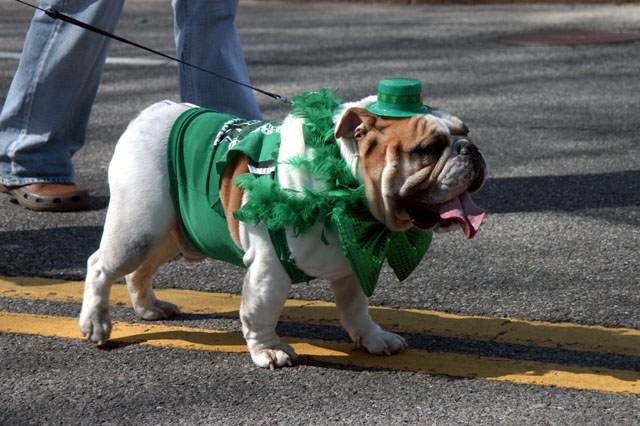
Nice ride, Rover.
Star of stars.^
The view from the Patrick Henry Hotel.^
Commercializing St. Patrick (with Ronald McDonald).^
Sen. Mark Warner and his new buddy.^
Mark Warner's new buddy's opinion of politics.^
This compilation is just random from the Roanoke St. Patrick's Day parade today. No more explanation needed or wanted, I'm certain.

The Faces of St. Paddy's Day in Roanoke

What's a parade without batons?^
Drum major of the Scotish variety.^
Brooklyn Tinsley is 7 and distinctly Irish.^

Another Irish lass.^
Now THAT is marketing.^

Nice tat on the right eye, ma'am.^
My old pal Tom is Irish, too.^
My granddaughter Madeline gives directions to her pals.^
Pals Steph and Bruce got to be judges. That's Steph's natural color.^
Star of 'How Green Was My Valley.'^

Green goes with everybody.^
Some Irish are prettier than others.^

Dressed in the old style.^

Ann Trinkle and her daughter.^

I can see beer in this guy's future. Green beer.^
Mayor David Bowers loves attention.^
Lemme take this call, honey. I'll be right back.^

My old buddy Dick Raymond was with the 29th Infantry on D-Day.^

Like mama, like daughter.^

Purple feathers mean he's the boss.^

Can you see through those things?
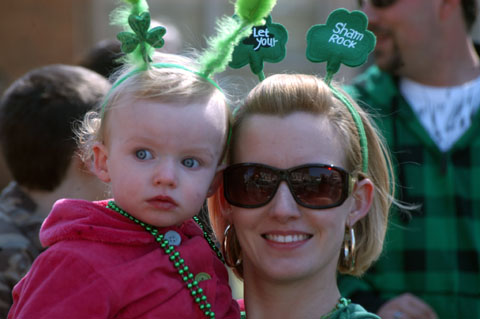
Roanoke's St. Patrick's Day Parade was this morning and the faces were the main draw for me. The crowd was huge and the parade was, as usual, about half military, police or right-wing politics, none of which interest me, so I just look the other way and shoot pictures. Fun time.

An Opportunity for Labor: Smarter and Wiser?

It is not quite the stretch you might imagine to equate the NFL players decertification of their union and subsequent lawsuit against owners (Millionaires, et. al. vs. Billionaires, et. al.) with Wisconsin Republicans' massive attack on state employee unions.

The most obvious difference, of course, is one of scale: Peyton Manning's millions per year compared to a state cop and his thousands. But there's a good bit more to it than that.

Employee unions of all kinds have their genesis in the same place: unfair management practices, whether it is coal mine owners making virtual slaves of coal miners or baseball owners owning the contracts of their players for as long as they want them with absolutely no opinion accepted from the player. Unions helped equalize the relationship in both those instances and in many more industries in America.

Pre-union "labor practices" didn't exist in this country. Owners simply treated workers any way they wanted, paid them as they chose, fired them at will, discriminated against them because they were African-American or Irish or women or had brown hair. The federal and state governments in the U.S. sent troops to quell labor unrest and in one instance (in West Virginia in 1922) actually sent its new air force to bomb striking miners.

Labor is not without fault in the current climate where it finds itself the underdog most of the time. Greed, affiliation with criminals and the idea that workers are entitled to certain wages, benefits and rights out of line with what most Americans enjoy has worked against the movement, which gave America its middle class. 

Those opposed to organized labor, led by the richest Americans, have brilliantly framed the current debate in tribal terms. Ours is a land of tribes and when you can set them at each other's throats, the people who benefit from their labor are served. Here, though, we have middle class workers in unions being opposed by middle class workers not in unions because of a few dollars difference in pay and benefits per year.

In the case of the NFL, it's simply a matter of scale. The owners have been given exception to normal labor rules and regulations for many years because of what they believe to be the special nature of their sport/business. Let these athletes be free, they reason, and prices will get out of hand. If you look at the price of a ticket to an NFL game (or an NBA game), you see we've achieved that union or no union.

It appears we'll lose pro football for a year and that Wisconsin's state employees will be left to fend for themselves. But the backlash is coming. It's coming soon and my guess is that labor, if it plays this one smart, will emerge much stronger and, I hope, a whole lot wiser.

Quote of the Day: Thanks, Scottie Boy

From the Banana Republic of Wisconsin, where Governor for Life Scott Walker and his goose-stepping brownshirts are re-defining what it means to be a union member we have this, from AFL-CIO President Richard Trumka (above), who is organizing to fight back:

"I guess I ought to say thank you particularly to Scott Walker. We should have invited him here today to receive the Mobilizer of the Year award from us."

Here's a story on labor's plans to counter-attack after public employees lost the right to negotiate (after making all kinds of pay and benefits concessions).

Building Regulation Sometimes a Lifesaver

Almost uniformally in this country, business owners will rank regulation among the most important detriments to profit. At Valley Business FRONT (the magazine I edit), we have just finished a story on manufacturing in this region and I heard over and over from owners that regulation is driving businesses overseas--even more so than inexpensive labor, some say.

Regulations can be strict, niggling and often marginal in their importance. Regulators can sometimes be overzealous. Regulation can be expensive (a good friend of mine is pouring $20,000 and about four extra months into complying with some Roanoke regulations she sees as marginal at best), time consuming and nerve-fraying.

But in Japan this morning, a lot of people are thanking the Buddha for that country's strict building codes. The codes are credited for saving many, many lives after yesterday's powerful earthquake left us horrifying scenes of destruction. This morning's New York Times story detailing Japan's efforts at minimizing earthquake damage with its strict building codes is revealing. The codes are expensive and time consuming to comply with, but when you look at what has been salvaged in the center of such utter destruction, can there be a question about their worth?

(Image from chinasmack.com)

Friday, March 11, 2011

FOI Workshops Scheduled in Roanoke April 27

The Virginia Council of Governments has scheduled a Freedom of Information seminar at The Roanoke Times' Barton Morris Conference Room April 27 9:30-3:30. This one's perfect for bloggers, journalists and ordinary citizens who want to know what government's doing.

The first workshop, from 9:30 to 12:00, is a FOIA workshop geared primarily toward citizens, bloggers and journalists, but will also be helpful for government employees. You'll learn the basics of making FOIA requests and learn tips and strategies from citizens, reporters and government about the best way to get the information you're seeking.

The second, from 1-3:30, is a records-management seminar geared primarily toward government employees in charge of managing records and/or filling FOIA requests. You'll learn tips from fellow public servants about how to make your records more accessible, thus making it easier and less time consuming to fill FOIA requests.

The cost is $20 for single workshops and $35 for both. Register here.

'Car Talk' Hires Tech Animal Expert

Kieran Lindsey of Tech will be a regular on 'Car Talk.'^
Kieran Lindsey, who directs the Natural Resources Distance Learning Consortium for Virginia Tech’s College of Natural Resources and Environment, has that distinction these days. She’s the new voice for wildlife on NPR’s “Car Talk,” one of the network’s most popular shows.

She’ll address cars vs. animals when the questions come in (like how to store the monkey in your take, maybe?). She’s been at Tech since 2008, earning all her degrees (she has a PhD) from Texas A&M.

She has headed up a nonprofit wildlife center in Houston, and been host for a weekly radio program, “Wild Things Radio,” which aired on public radio in Albuquerque, N.M. In May, she will be a keynote speaker at the International Urban Wildlife Management Conference in Austin. A lot more people will know her by then.

Apples and Pears, Fat Asses and Heart Attacks

OK, Lardos, there's a new study out there that'll interest you. It's apples vs. pears and you don't get to eat either, though maybe you should have one of each today. 

The study is a close look at visceral fat that surrounds surrounds the the organs in the abdominal area and the subcutaneous fat found under the skin. The former is defined in apple shaped people, the latter in pear shapes. Women know all about this stuff. Men tend not to pay that much attention. Maybe they should.

The British study from Cambridge University looked at 220,000 fat asses in 58 studies over a decade and found that "
having a higher waist-to-hip ratio was no better a predictor of heart disease and stroke risk than being generally overweight, as measured by body mass index."

Neither shape is healthy, but we're know from past studies that apples carry a risk of heart disease and pears tend toward osteoporosis, varicose veins and menopausal symptoms (the latter is mostly in women). Pear-shaped women and apple-shaped men have more risk for life threatening blood clots, according to the American Heart Association.

There is some contradiction, according to a study in Lancet, the British medical equivalent of JAMA. The study "found the risk of heart attack was not increased by fat being concentrated around the waist.

It contradicts previous work that found overweight people with 'apple shaped' bodies were three times as likely to suffer heart attacks than those with more generally distributed fat."

The British study notes that "around three-fifths of Type 2 diabetes [cases] and one-fifth of heart disease cases are attributable to excess body fat. Six cancers are also linked to obesity."

My guess is that the encouraging side here--and the one that doesn't contradict itself--is that celery-shaped men and women don't have much of any of those worries.

(Graphic from brainyweightloss.com)

Thursday, March 10, 2011

Wasena Park Flood Reduction: It's Working

The new bridge at Vic Thomas Park has plenty of room.

Debris on new low-water bridge.
Water went over this bridge, as usual.
Water is high, but causing no damage.
Water is far from the greenway path.
Here are some photos, taken late this afternoon in Wasena Park, site of recent flood control efforts by Roanoke (working with the federal government). It's working. Quite well, thank you.

The rain of the last few days and the heavy squalls we had this afternoon would have flooded this entire area a year or two ago, but all the work that has been done to reduce the flooding has left the park with a high river that is causing little or no damage.

Kudos to the boys who did the work.